
Rooster Run from Mascot offers a distinct interpretation of crash-style mechanics by introducing movement-based decision points and animated progression. The central element is a rooster advancing across a horizontal path, where each step represents a higher payout. Instead of passively observing rising values, players actively choose between advancing or locking in their current total. The outcome hinges on timing, calculated risk, and mode-specific behavior.
Rooster Run core concept and structure
Rooster Run replaces reels and spins with a sequential movement model. The rooster progresses tile by tile, with each jump raising the multiplier. If the step lands on a losing tile, the round ends and no payout is awarded. The objective is to advance as far as possible without triggering a crash point.
The layout prioritises clarity: animated movement and a visible multiplier tracker take center stage. Unlike many crash titles that rely on unpredictable spikes, Rooster Run introduces fixed segments that give players a clearer sense of pacing and short-term probability.
Step-by-step vs Instant mode
Rooster Run offers two distinct formats for movement and risk handling:
- Step-by-step: The rooster moves forward one tile at a time. After each jump, players can choose to stop and collect the payout or continue. This format emphasizes interactive control, allowing decisions to be made throughout the round.
- Instant: A single attempt is made to reach the selected multiplier. The outcome is determined immediately – either the full payout is granted, or the round ends without return.
These modes cater to different preferences. Step-by-step appeals to those seeking incremental control, while Instant offers a faster pace with fewer decisions per round.
Risk levels and volatility control
At the beginning of each round, players choose from three risk configurations that affect the layout and outcome potential:
- Low: A longer sequence of tiles with modest multipliers. This setting reduces the impact of individual decisions and extends the session duration.
- Medium: A balanced path that combines moderate progression length with competitive rewards.
- High: A compressed structure featuring fewer steps and significantly higher volatility. Maximum payouts can reach up to x10,000.
The selected level shapes the step distribution and payout dynamics for the round. Lower settings allow gradual multiplier accumulation. Higher settings increase pressure and require tighter decision-making windows.
Game specifications
| Feature | Details |
|---|---|
| Title | Rooster Run |
| Developer | Mascot Gaming |
| Type | Crash Game |
| RTP | 95% |
| Max Multiplier | x10,000 |
| Modes | Step-by-step, Instant |
| Volatility Settings | Low, Medium, High |
| Customization | Avatars, themes, interface |
Customization and ranking system
Rooster Run from Mascot includes a ranking component that tracks player activity across the year. Each wager contributes experience points toward a cumulative rank, which determines access to cosmetic upgrades. These additions do not affect game outcomes but offer visual personalization for returning players.
Progress through the ranking system unlocks new rooster appearances, interface themes, and style variations. Available rooster outfits include options like ninja, magician, and farmer, while UI elements can be adjusted through unlocked color schemes. All customizations are optional and serve to individualize the in-game presentation.
Leaderboards and betting history
Rooster Run includes three dedicated leaderboards that display real-time and historical betting data:
- All Bets: Lists current active wagers placed during the ongoing session.
- Top: Highlights the highest recorded multipliers and notable wins over a rolling timeframe.
- My Bets: Provides a personal log of previous rounds, including cashouts and selected risk levels.
These features allow players to monitor broader trends, assess potential strategies, and track personal progress. While the system adds a light competitive layer, it remains non-intrusive and does not require interaction with other users.
How to play Rooster Run
Step-by-step instructions
- Select a risk level: Low, Medium, or High.
- Set your desired wager.
- Choose a mode of play: Step-by-step or Instant.
- In Step-by-step mode, click “Forward” to attempt the next multiplier.
- Use the “Cashout” button before the rooster lands on a losing tile.
- Start a new round using the same or adjusted parameters.
Each action influences the outcome. There are no guaranteed wins, and the mechanics are designed to reward deliberate pacing and timely choices over fixed routines.
Strategies for playing Rooster Run
Rooster Run requires more than reactive tapping. Each decision to advance involves weighing potential gains against increasing failure probability. Players often build structured approaches to avoid emotional play and minimize unpredictable outcomes.
Early cashout strategy
This method is frequently applied in high-risk sessions. Due to the limited number of steps, players often choose to exit after reaching moderate multipliers – typically between x2 and x5. The focus shifts from pursuing the maximum multiplier to protecting small wins and reducing exposure to early crashes.
Step count targeting
Another approach involves setting a fixed number of jumps as the exit point, rather than tracking multiplier values. For example, in medium-risk sessions with approximately 25 tiles, a player might consistently cash out after 10 to 12 steps. This structured tactic introduces discipline and removes guesswork from the round-by-round decision process.
Incremental progression in autoplay
Activating autoplay in step-by-step mode provides a blend of automation and control. The rooster advances automatically for a predefined number of steps, while players retain the ability to intervene manually. This setup allows for mid-round decisions based on observed patterns, visual pacing, or personal judgment, offering structured flexibility within the round.
Targeted instant leaps
In Instant mode, players often assign a predefined multiplier and allow the game to run repeated short sessions. This method focuses on volume – using multiple attempts to balance probability over time. It suits those looking for quicker outcomes without step-based input during each round.
Comparison: Rooster Run vs Chicken Road
Although both Rooster Run and Chicken Road are based on sequential crash mechanics, their implementation and design choices reflect different priorities.
| Feature | Rooster Run | Chicken Road |
|---|---|---|
| Risk levels | Three options: Low, Medium, High. | Predefined by version (e.g. Chicken Road 2 offers higher difficulty). |
| Step logic | Determined by player input and session setup. | Linear route with outcomes triggered by random internal checks. |
| Visual style | Minimal interface with player avatar customization. | Colorful design with animated elements and themed visuals. |
| Game pace | Two selectable modes: Instant and Step-by-step. | Fixed tempo across all rounds. |
| Autoplay system | Advanced tools including stop triggers and session control. | Limited or unavailable automation options. |
| Max multiplier | Up to x10,000. | Generally lower ceiling. |
Rooster Run introduces deeper customization and round-by-round control. Chicken Road focuses on visual variety and faster pacing, while Rooster Run encourages strategic planning and consistent adaptation throughout play.
Where to play Rooster Run
Rooster Run is currently integrated into several established online casinos. These platforms provide access to both live and demo modes, offering flexible entry points for different player preferences:
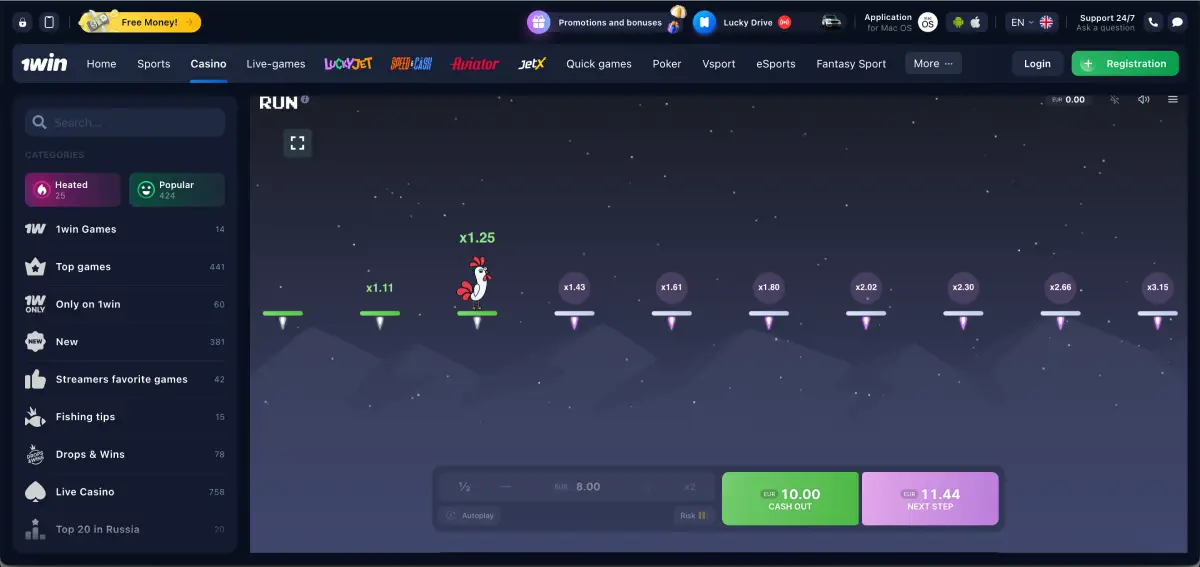
- 1win: Among the first to list Rooster Run, this platform supports fast crypto withdrawals and features ongoing promotions connected to crash mechanics.
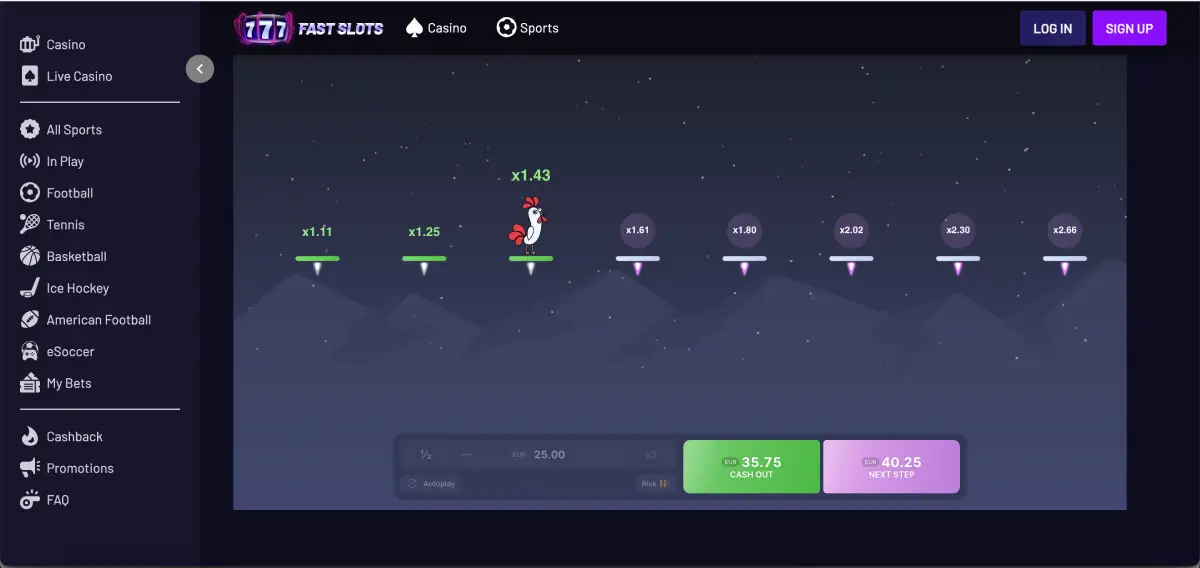
- Fast Slots: Focused on lightweight arcade-style titles, the site offers a clean interface that complements Rooster Run’s structure.
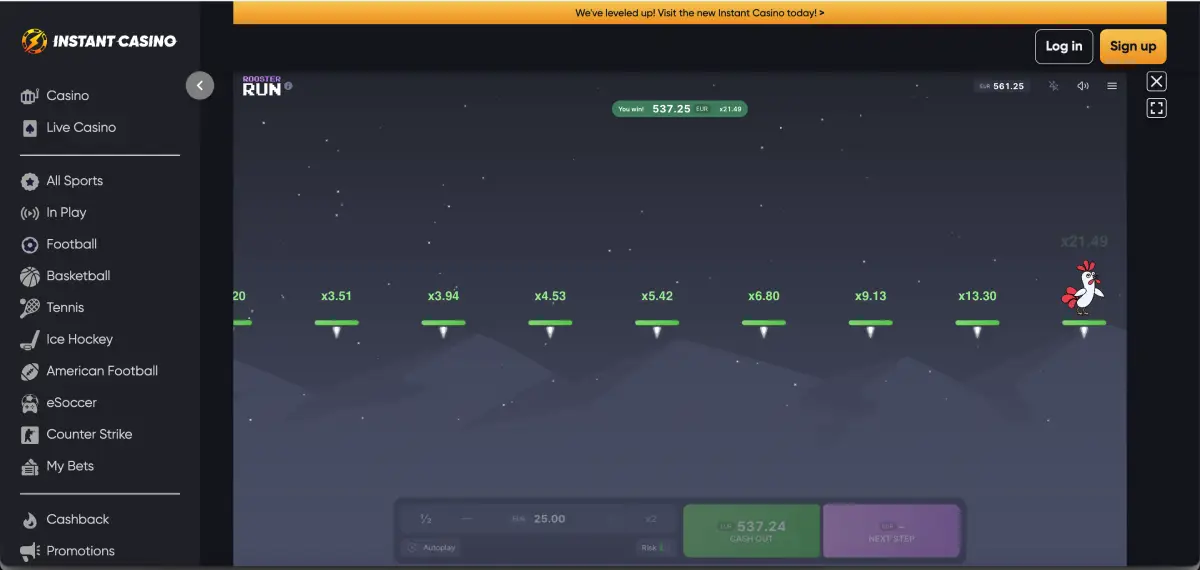
- Instant Casino: Known for seamless loading and uninterrupted gameplay. Rooster Run performs smoothly in both manual and automated configurations here.
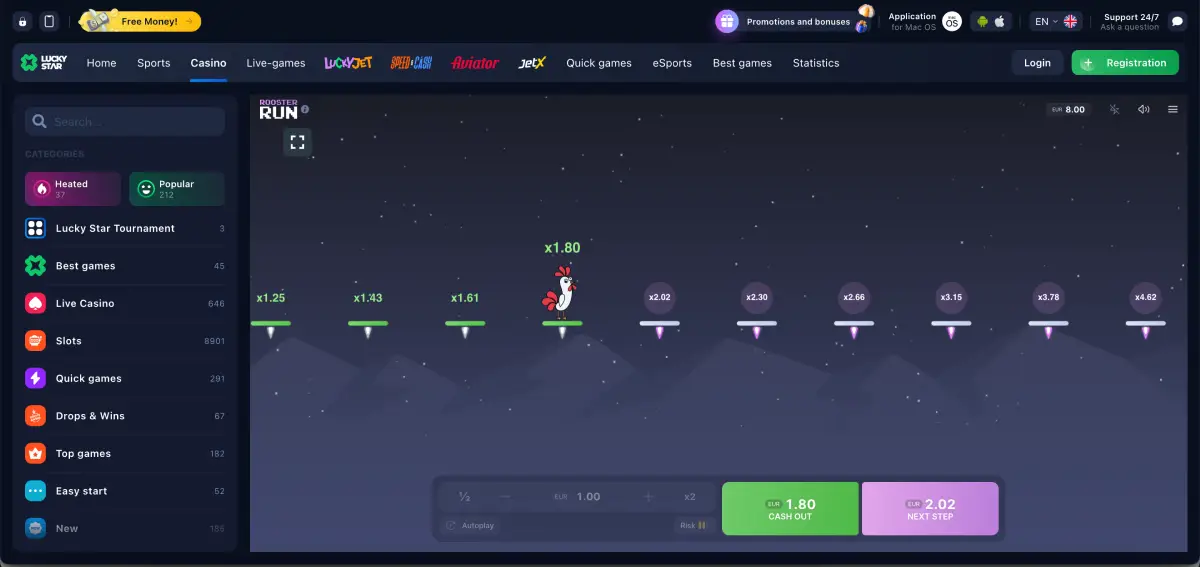
- Lucky Star: Combines gameplay with progression elements like tournaments and loyalty ranking, enhancing the Rooster Run experience over time.
Each of these casinos allows users to test Rooster Run without financial commitment or switch to real-money rounds once familiar with the game’s structure.
Demo mode: play Rooster Run without an account
Most platforms that feature Rooster Run also provide access to a no-registration demo version. The gameplay mechanics remain identical to the real-money format, but all wagers are simulated using virtual credits.
Why use demo mode?
- Explore how different risk levels affect the number of available steps.
- Test both Step-by-step and Instant modes without commitment.
- Practice when to exit using the cashout feature under no-pressure conditions.
- Track multiplier patterns across multiple trial rounds.
Demo mode is available immediately on sites like 1win, Instant Casino, and Lucky Star. There’s no need to provide contact information – the game loads directly in the browser for trial use.
Final thoughts on Rooster Run by Mascot
Rooster Run takes a structured approach to the crash genre, introducing selectable risk levels, cosmetic personalization, and a functioning leaderboard without overwhelming the interface. Its core mechanic – step-based advancement – places control in the player’s hands rather than relying on automated outcomes or layered bonuses.
With two available formats – manual progression and single-attempt instant runs – players can choose between deliberate pacing or quick resolution. The route to the maximum multiplier of x10,000 is clearly defined, with no hidden mechanics or unpredictable triggers.
By minimizing distractions and emphasizing decision-making, Rooster Run delivers a streamlined experience focused on timing, movement, and controlled volatility. It’s designed for those who prefer clarity in structure and autonomy in execution.
