
At first, Chicken Road might give off the impression of a light arcade title – but beneath the playful visuals lies a high-volatility crash mechanic. Each move pushes the multiplier higher, but also brings the session closer to failure. This is not a game you watch; it’s one you navigate with focus. Timing decisions define outcomes, and a single step too far can erase a solid run.
The format rewards players who approach it with structure. It’s less about luck and more about knowing your limits – when to move, when to stop, and how to treat each round as its own closed event. The moment you hit Cash Out, your decision becomes final – and whether it was early or late often matters more than the odds themselves.
This guide covers everything you need to understand Chicken Road: from basic movement and game logic to deeper strategy layers and behavioural patterns that influence results over time. Whether you’re opening the Chicken Road app for the first time or looking to refine an existing approach, the following sections will walk you through the essentials.

Understanding Chicken Road gameplay
Chicken Road revolves around a simple premise: guide a chicken across a trap-filled path, one tile at a time. Each forward move increases the multiplier, and with it – both potential reward and risk. The objective is to collect as many safe steps as possible, then exit before hitting a hidden fire tile.
Unlike traditional crash games that operate on fixed pacing, here the tempo is entirely in the player’s hands. You control each step manually, choosing when to move forward and when to cash out. That manual rhythm turns the experience into a blend of calculation and timing – more structured than slots, and far more interactive than auto-crash titles.
How to play Chicken Road
Each round follows a repeatable cycle, but outcomes shift based on difficulty and timing. Here’s the typical flow:
- Choose your stake – values usually range from $0.01 to $200, depending on the casino.
- Select a difficulty: Easy, Medium, Hard, or Hardcore.
- Press “Play” to load the grid.
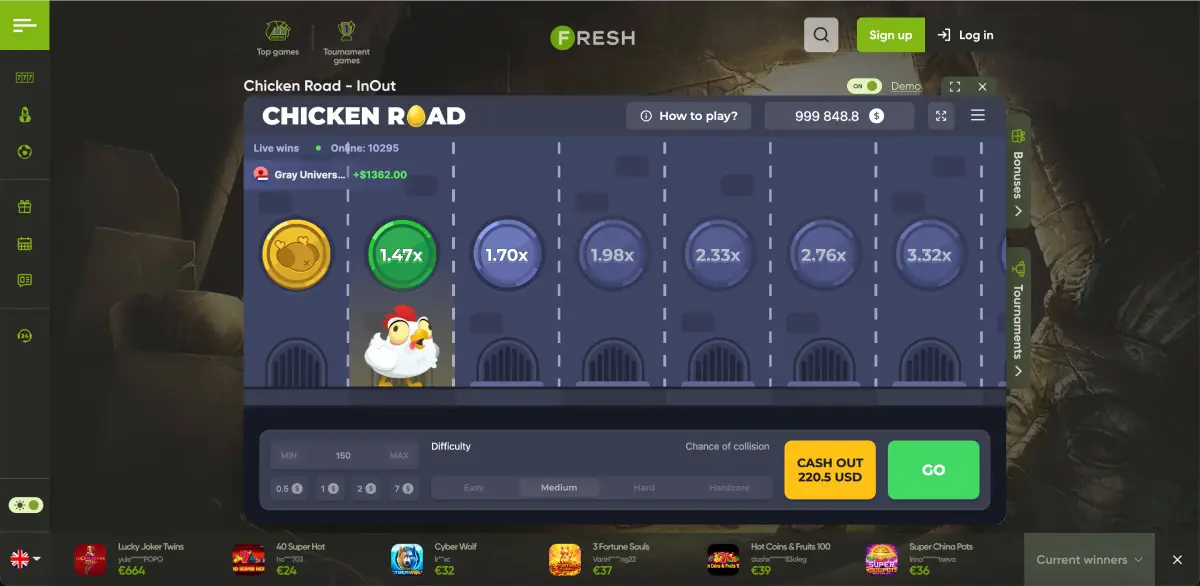
- Use the “Go” button to advance one tile, or “Cash Out” to secure your current multiplier.
- Trigger a trap and the round ends – with no payout.
Difficulty levels and payout structure
Each difficulty setting adjusts the number of tiles, base multiplier, and volatility. Fewer tiles generally mean higher risk per step – but also steeper potential returns.
| Difficulty | Total tiles | Initial multiplier | Max possible multiplier | RTP |
|---|---|---|---|---|
| Easy | 24 | x1.02 | x24.5 | 96% |
| Medium | 22 | x1.11 | x2,254 | 88% |
| Hard | 20 | x1.22 | x52,067 | 80% |
| Hardcore | 15 | x1.63 | x3,203,384 | 60% |
Higher difficulties significantly increase the reward curve, but at the cost of reduced RTP and tighter trap distribution. Choosing the right setting depends on your bankroll strategy, session goal, and appetite for loss streaks.
Chicken Road strategy: how to win smarter
There’s no algorithm to beat Chicken Road – but there is structure in how you play. Since each round is powered by a Provably Fair system, trap placement is random and unchangeable. That said, outcomes vary dramatically based on your choices during the round.
Winning consistently isn’t about predicting trap locations – it’s about limiting unforced errors. Most failed sessions aren’t the result of unfair rounds, but of poor timing, inconsistent exit logic, or betting beyond balance thresholds.
The key variables in strategic play are:
- Timing: Define cashout zones before the round starts. Stick to them regardless of temptation.
- Discipline: Avoid chasing high multipliers unless you’re playing at lower stakes. Build momentum through small but consistent exits.
- Mode selection: Stay in Easy or Medium difficulty until you’ve tracked behavior patterns over dozens of rounds. Hardcore is designed for volatility, not regular wins.
- Session limits: Play in cycles – short bursts with capped wins or losses – to avoid burnout and tilt.
Chicken Road isn’t solved by instinct. It rewards players who approach it like a timing puzzle, not a chase for one-off jackpots. Track your rounds, review where you exited, and treat every click as part of a broader pattern. Smart play isn’t about winning every round – it’s about losing better when it happens.

Why you need a Chicken Road strategy
Unlike slots or auto-run crash games, Chicken Road hands full control to the player. Every step, every pause, and every exit is up to you. That interactivity brings depth – but also introduces pressure. Without a framework, decision fatigue builds quickly, leading to premature exits or overreach.
The most common reason players lose in Chicken Road isn’t bad luck – it’s inconsistency. Switching approaches mid-round or chasing after a previous loss often causes more damage than the traps themselves.
To manage this, structure matters. Below are strategy formats tested by players who focus on timing, not emotion:
Core strategic approaches
1. Quick Exit (short steps)
Ideal for Easy or Medium mode. Take 2–3 steps, then exit. You’ll rarely see x10+, but the goal here is stable, repeatable outcomes with minimal exposure to trap zones.
2. Fixed step count
Decide in advance how many tiles to cross – say, 4 every round – and stick to it regardless of grid mood. This removes hesitation and standardises decision-making across sessions.
3. Risk ladder
Start on low stakes and easy difficulty. If you generate profit, use that surplus to enter higher levels (e.g., Hard or Hardcore). This shields your base balance while giving room for occasional big-risk rounds.
4. Flat betting
Stick to a consistent amount per round – such as $1 or $2. The focus here is building rhythm and mastering cashout timing, rather than reacting to streaks or attempting to recover losses through increased bets.

5. One Hardcore attempt
Limit yourself to a single Hardcore session per play cycle. Use no more than 1% of your total balance. Think of it as a bonus test – not a strategy base. The reward curve is massive, but survivability is low.
Each of these strategies helps neutralise impulse and introduces structure to what would otherwise be reactive gameplay. Over time, consistent behaviour tends to outperform streak-chasing and random decisions.
Additional Chicken Road strategies (real session examples)
Beyond fixed rules and base mechanics, advanced players often apply structured betting systems to Chicken Road. While none guarantee wins, these frameworks introduce rhythm and limit emotional volatility across sessions.
6. Reverse Martingale (Paroli method)
- Start with $1.
- Win – increase to $2.
- Win again – raise to $4.
- Lose – reset to $1.
This approach focuses on short win streaks. The key is to define a cap – such as three consecutive wins – before voluntarily resetting. That locks in profit and avoids overextension during streak momentum.
7. Incremental raise with reset
- Start at $2 – win – raise to $3.
- Next round $3 – win – raise to $4
- Lose – restart at $2.
This strategy leverages momentum while keeping a strict stop-loss after a single failed round. It balances progression with embedded reset logic to avoid steep drops after a gain cycle.
8. Session cap and bankroll management
- Total balance: $50.
- Play in 10-round cycles of $1 each.
- Stop if profit hits $10 or losses reach $5.
This model builds a structure around session length and emotional control. It’s especially useful for avoiding tilt after downswings, and promotes a clear mental break after defined thresholds.
9. Two-round profit lock
- Round 1: Bet $2 – take 3 steps – cash out at x2.5 – win $5.
- Round 2: Bet $2 – take 2 steps – cash out at x1.8 – win $3.6.
- Total session profit: $4.6.
This strategy keeps sessions intentionally short. Designed for mobile or break-time play, it helps prevent mental fatigue and allows for quick positive outcomes without prolonged exposure.

Used consistently, these formats reduce reliance on gut decisions and help bring structure to what is otherwise a high-variance environment.
Risk management in Chicken Road
In Chicken Road, most losses aren’t the result of unfair mechanics – they come from hesitation or overconfidence. Knowing when to exit, how much to stake, and when to pause are far more important than chasing multipliers.
Here are core habits that can help you control exposure and extend session longevity:
- Define your maximum loss before the session starts – and respect it regardless of momentum.
- Use Cash Out more often than your intuition tells you. Waiting “just one more step” is the downfall of many rounds.
- Resist the urge to raise your stake after a loss. Chicken Road isn’t roulette – recovery through aggression rarely ends well.
- Switch difficulty levels based on your mindset. If you’re unfocused, stick with Easy or Medium mode.
- Set a time limit alongside your financial limit. Fatigue leads to poor exits.
Common mistakes to avoid
Some behaviours are known to increase risk without adding strategic value. Recognising and avoiding them helps maintain long-term consistency:
- Targeting top multipliers: Hardcore mode advertises huge returns, but reaching those extremes is rare. Don’t shape your plan around statistical outliers.
- Going all-in: Betting your full balance removes flexibility and increases emotional attachment to each round. Stay within 1–5% of your total bankroll per play.
- No predefined exit: Starting a round without a clear stopping point shifts decisions into reactive mode. Have an exit multiplier in mind before clicking “Play.”
- Emotional follow-ups: Re-entering after a burn due to frustration usually compounds the loss. Take a pause – even one minute of distance can reset perspective.
Example: stable vs. reckless approach
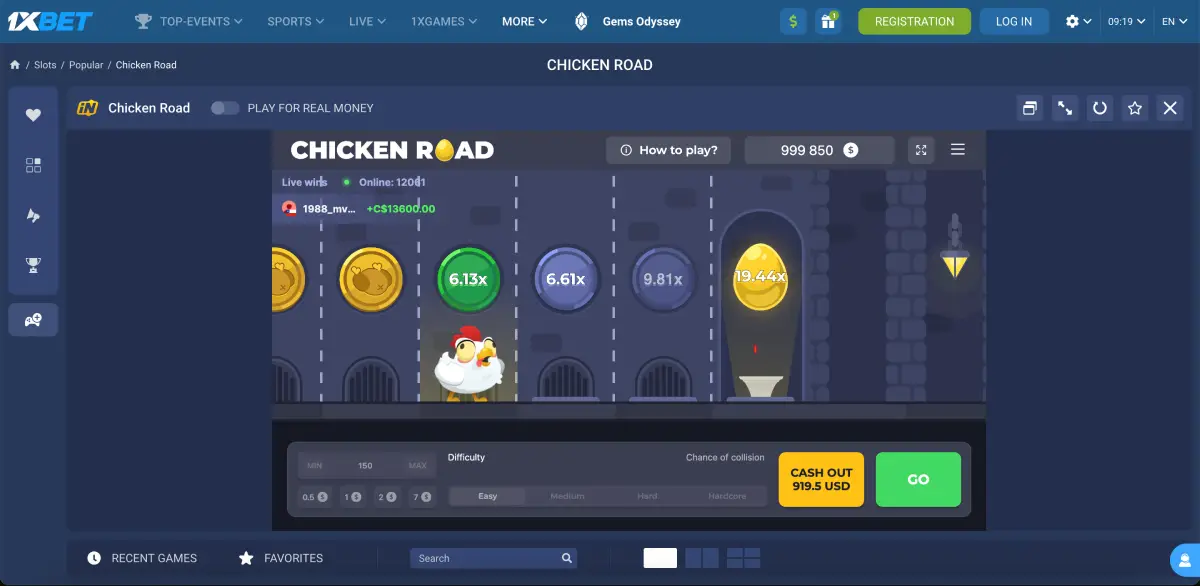
Player A: Bets $5 in Easy mode. Takes 3 steps, reaches x2.3 multiplier, cashes out with $11.5. Repeats same approach on second round, finishes with $21.5 total. Ends session.
Player B: Same starting point. Wins first round, then jumps to Hardcore with full balance. Hits a trap on the first tile — total loss in two rounds.
The takeaway? Chicken Road rewards structure and measured action. If you approach it as a decision-making challenge – not a chase for adrenaline – the game opens up room for consistent, controlled outcomes.
