
Chicken Run from PoggiPlay is a turn-based crash game built around sequential risk decisions rather than spinning reels. The theme follows a chicken making its way through a stylised jungle environment, rendered in a clear and functional cartoon style. The layout consists of a linear column path, where each move forward increases the payout multiplier.
At every step, players face a binary decision: collect the current multiplier or continue forward. Progression adds potential reward, but also the chance of immediate loss, as one of the tiles in each column contains a hidden trap. This structure places emphasis on timing and judgment as core gameplay elements.
The game features four selectable volatility modes. These alter the number of columns and the distribution of traps, shifting the risk-reward dynamic. Shorter, high-volatility paths can lead to faster rounds with higher multipliers, while longer sessions offer more controlled progression.
Chicken Run has a return-to-player (RTP) of 95.00%. The top payout is capped at 5,000× the initial stake and is available in the most difficult mode, which consists of a condensed 10-step path. The base mechanic is consistent across modes, with variation coming from the density of safe tiles and trap frequency.
Chicken Run Game Overview
| Title | Chicken Run |
|---|---|
| Type | Crash Game |
| Developer | PoggiPlay |
| Theme | Animals, Jungle, Adventure |
| Layout | Linear progression with selectable column paths |
| Volatility | Adjustable by player |
| RTP | 95.00% |
| Core Mechanics | Turn-based movement, crash logic, step-based cash out decisions |
| Bonus Feature | Escalating multipliers tied to step count, four selectable difficulty levels |
| Multiplier | Yes |
| Max Win | Up to 5,000x the wager |
Chicken Run Slot Review
Chicken Run by PoggiPlay moves away from the conventional reel-and-payline model that dominates most online slots. Instead, it applies a crash-style format built on incremental decisions and rising tension. The game centres on guiding a chicken across a linear path, where each successful move forward increases the payout multiplier.
Rather than spinning reels with predetermined outcomes, Chicken Run offers direct input and full control over round progression. Each step introduces a calculated risk – players must choose whether to cash out their current winnings or continue forward, knowing that a single misstep ends the session.
The gameplay is supported by four selectable difficulty settings. These modes adjust the number of columns, trap density, and potential payout curve. This configuration allows players to determine the level of volatility before starting the round, introducing a strategic layer to game setup itself.
Chicken Run relies on one core mechanic, executed with clarity and purpose. Its structure prioritises decision-making and session control over traditional slot elements like symbols, paylines, or bonus rounds.
The Core Gameplay Loop and Strategic Choices
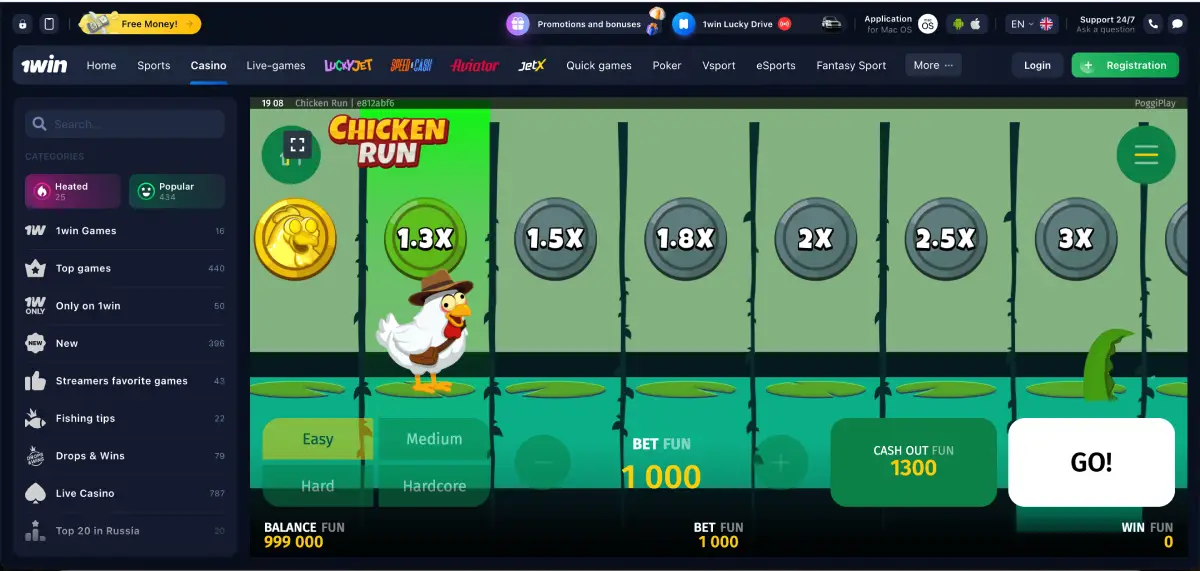
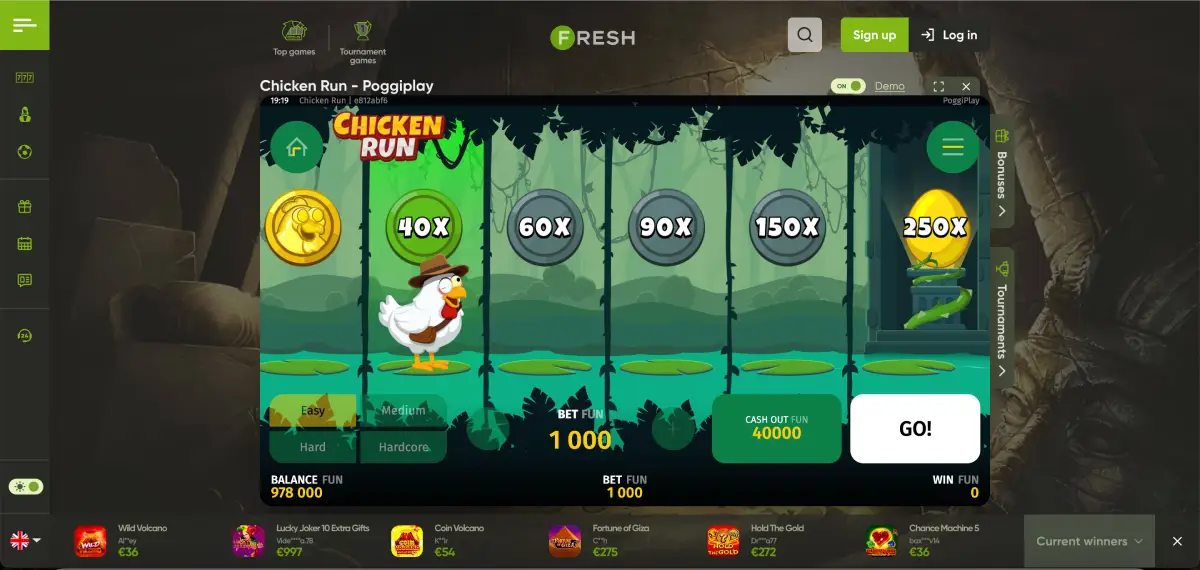
The main gameplay in Chicken Run unfolds through a series of discrete, high-impact choices. A round begins once a wager is placed and the “GO!” command is triggered. The character – a chicken outfitted with a satchel and explorer’s hat – automatically advances to the first column in a linear path. This opening position displays an initial multiplier applied to the base bet.
From this point, the core loop begins. After each successful move, the player must decide: collect the current winnings via the “CASH OUT” button or continue to the next column in pursuit of a higher multiplier. This decision recurs after every safe advance, framing each round around personal judgment and timing rather than preset game flow.
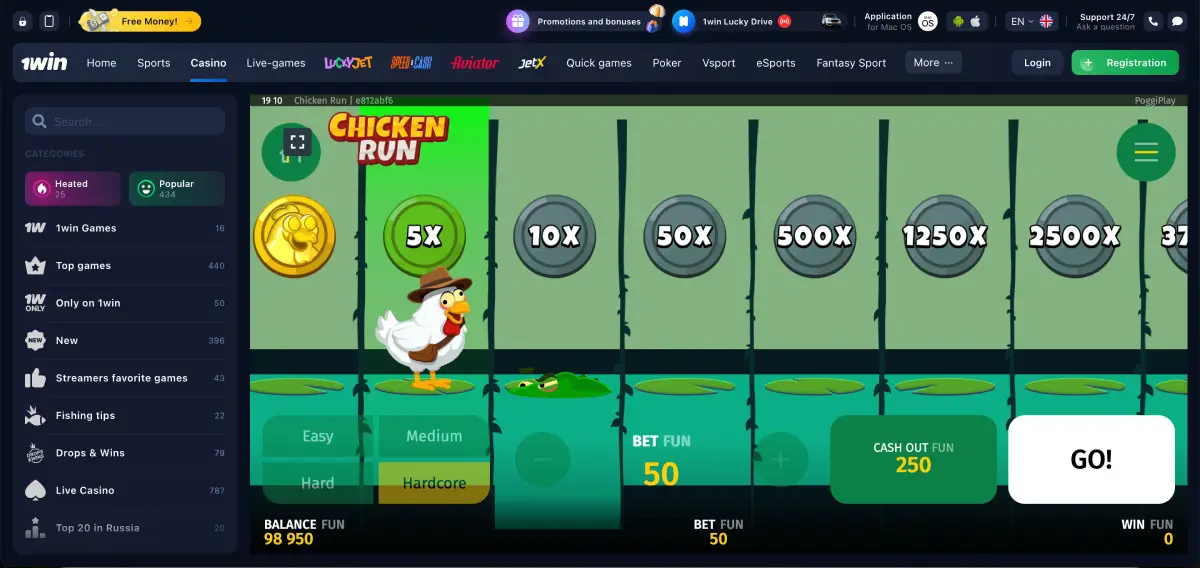
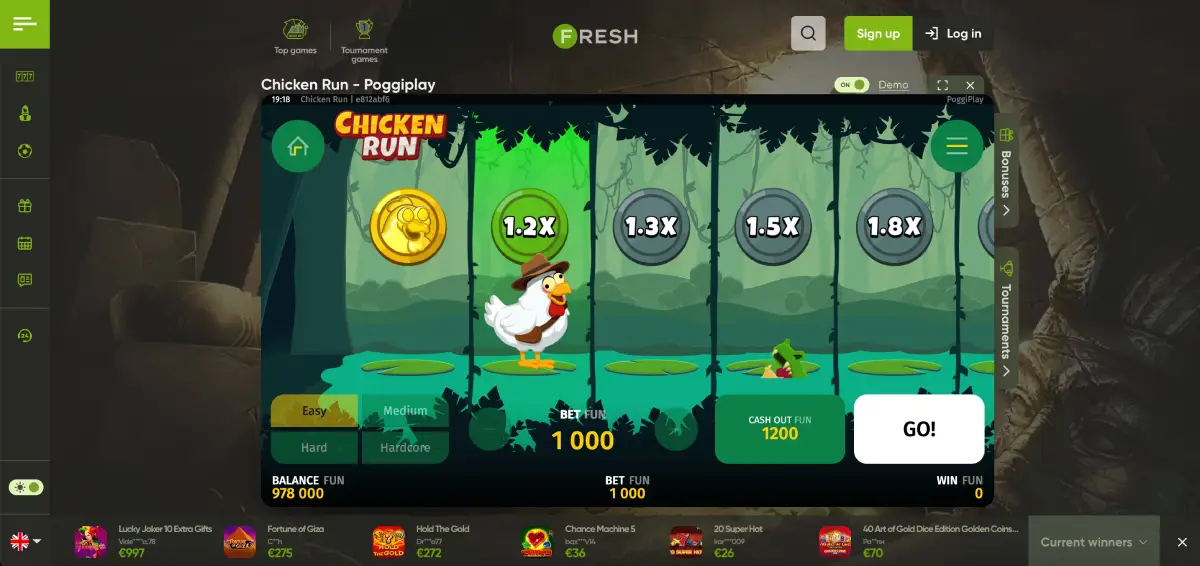
Each column contains a hidden outcome. One route progresses the game and increases the multiplier; the other triggers a trap – visualised as a crocodile – that ends the round immediately. A failed step results in the total loss of the wager and any accumulated gains. The feedback is immediate: a successful move displays a new multiplier, while failure resets the session with a distinct animation.
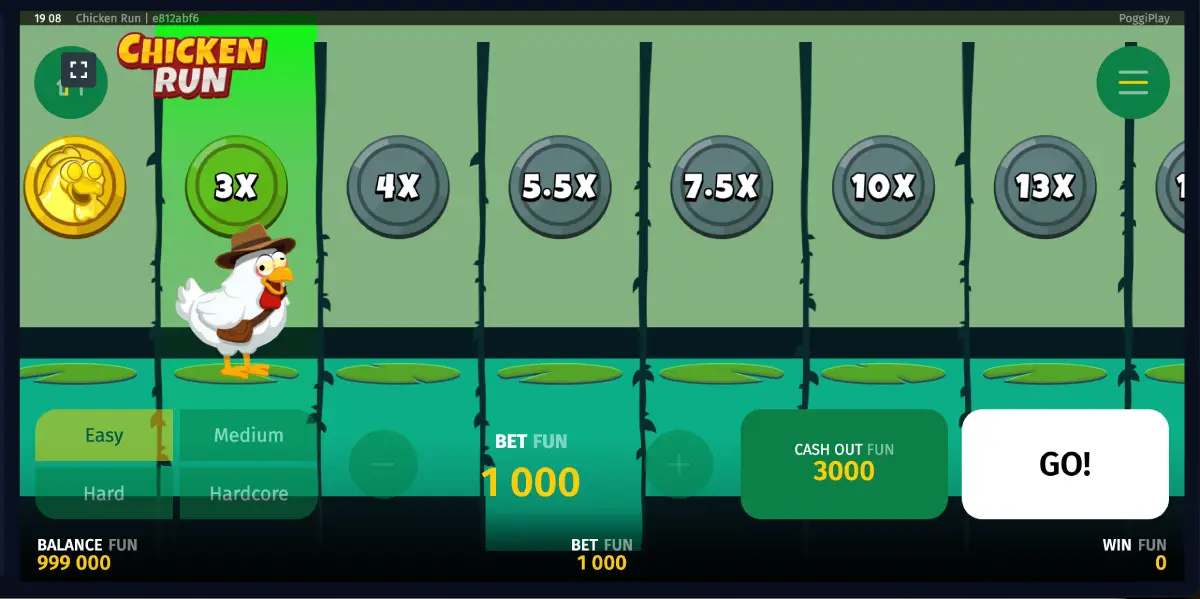
Risk calibration is further structured through a selectable difficulty setting. Before play begins, users choose from four modes, each with fixed path lengths and payout parameters. These settings directly impact the round’s volatility, adjusting both the risk per step and the overall distribution of rewards.
Easy mode features a 20-step path with gradual multipliers. It offers longer sessions and lower short-term exposure, appealing to cautious strategies. Hardcore mode, by contrast, reduces the path to 10 steps and introduces a higher probability of failure at every move. It begins at a neutral 1.0x multiplier, offering no return for the first advance. However, successful progression dramatically increases the potential payout – up to 5,000× the initial stake. Medium and Hard modes provide intermediate pacing and reward scaling, allowing players to tune the risk profile based on personal preference.
This model places volatility control entirely in the player’s hands before any money is committed. For those interested in the exact multiplier distribution across modes, the demo version includes a built-in reference chart, accessible through the “(i)” information button within the interface.
Visual Presentation and Thematic Execution
Chicken Run adopts a clean 2D cartoon aesthetic, prioritising visual clarity over intricate detailing. The protagonist – a plainly rendered chicken – is given just enough character to support the game’s tone without shifting focus away from gameplay. The background consists of a simplified jungle swamp environment, built from broad green and blue hues that frame the setting without overwhelming the interface.
Interface elements are designed for function. Buttons, bet displays, balance indicators, and difficulty selectors are large, clearly labelled, and positioned to minimise cognitive load. The layout resembles that of a mobile-first design, where responsiveness and accessibility are prioritised over decorative elements.
Animations play a practical role in the feedback system. A successful move triggers a short, purposeful forward strut, paired with a multiplier pop that reinforces progress. On failure, a crocodile appears with an abrupt “chomp” animation, signalling the end of the round. These transitions are concise and legible, effectively communicating game states without relying on complex effects.
The overall tone is deliberately light, even with the presence of risk. Visual and audio components remain restrained: simple interface sounds, short confirmation chimes, and an audible cue for failed rounds form the soundscape. This restraint supports the game’s mechanical clarity, keeping the focus on timing and decision-making rather than immersion or narrative depth.
As a whole, the visual framework serves the core mechanic directly. The art direction reinforces the structure of repeated risk assessment without distraction. The “Chicken Run” theme mirrors the gameplay loop – incremental movement with binary outcomes – and the presentation ensures that this loop remains central at every point in the session.
Deconstructing the Game Mechanics
Chicken Run does not operate within the framework of traditional slot machines. It has no reels, paylines, or symbols to align. Instead, the gameplay is built on a binary path system: each column contains one of two outcomes – Safe or Danger. The core mechanic hinges on probabilistic events that are resolved independently for each step forward.
Player interaction does not affect the randomisation process. The outcome for each column is pre-determined within the game engine using a fixed probability model. However, the player’s decision to initiate a “CASH OUT” introduces a layer of agency. At any moment, they can exit the round and collect the current multiplier, removing themselves from further risk.
The game’s stated RTP is 95.00%, calculated over long-term simulated play and incorporating all difficulty levels and decision patterns. In this structure, RTP reflects a statistical average based on varying strategies – not a fixed outcome per session.
Outcomes in real play vary widely depending on player behavior. A cautious approach that consistently exits after two or three steps will yield frequent, low-value returns with low volatility. In contrast, an aggressive strategy that targets high multipliers may result in extended losing streaks, offset by rare but substantial wins.
This mechanic hands session volatility to the player. Rather than defining fixed payout bands, the game allows individuals to determine how much risk they introduce into each round, shaping both experience and results within the same probability framework.
Player Agency and Risk Management
Chicken Run places decision-making at the centre of its design. Unlike traditional online slots where the player’s role is limited to initiating spins, this format requires continuous input. After each successful step, the player must reassess the situation and choose whether to cash out or continue – a repeated, high-stakes calculation that defines the core loop.
This structure creates a constant tension between security and ambition. The critical question – “Is the next step worth the accumulated risk?” – is posed after every move. The presence of escalating multipliers heightens this decision, introducing a psychological element tied to loss aversion and reward expectation.
The game subtly explores behavioural patterns such as the sunk cost fallacy. As the multiplier grows, the temptation to continue increases, even when the probability of success diminishes. Opting out with a 10× multiplier may feel like a win, but the knowledge that a 12× or 20× was theoretically possible often adds a layer of post-decision doubt. This internal dialogue is a core component of the game’s engagement model.
Chicken Run is structurally aligned with players who prefer direct influence over outcome and enjoy iterative risk-based scenarios. It presents all variables transparently – step count, difficulty, and multiplier trajectory – allowing users to understand the system and assume full control over session flow. Players who gravitate toward automated features, randomized bonuses, or complex visual sequences may find the active nature of play more demanding.
The game’s design places responsibility for each round’s result squarely on the player’s own judgment. PoggiPlay has constructed a system that is unambiguous in its function: each round ends not by chance alone, but by the player’s decision to advance or collect.
